
A drawdown limit you only find out about once you've hit it is a limit you've already breached. By then the damage is done — a failed prop-firm challenge, a blown account, a client's money past the line you promised to hold. Drawdown alerts exist to reach you before that point, while there's still a decision left to make.
Setting your limit
You set one figure per account: the drawdown you never want to cross. Enter it in pounds or as a percentage — say £2,000 on a £25,000 account, or 8%. That's your line. Karnek then measures the account's live drawdown against it, continuously, and counts how close you are as a share of that limit rather than as a raw number you'd have to do sums on.
What 80% and 90% mean
The alerts fire at two points on the way to your limit, not at the limit itself:
- 80% — the first warning. On a £2,000 limit, that's £1,600 down. The account is well into the range you set aside, and it's time to pay attention: ease off, reduce size, or look at what's driving the loss.
- 90% — the closer, more urgent one. That's £1,800 down on the same limit. You've £200 of room left. This is the one that says decide now.
Two stages, because a single alert is always wrong in one direction. Fire it early and it's noise you learn to ignore; fire it late and it arrives after the choice is gone. Warnings at 80% and 90% bracket the moment that matters.
Why the early warning matters
For anyone on a funded challenge, this is the whole game.
On a prop-firm challenge the drawdown line isn't a guideline, it's a hard floor — cross it and the account is gone, fee and all, whatever the balance was doing that morning. The gap between 90% of your limit and 100% of it is the only room you get to react in. An alert at £1,800 of a £2,000 limit is the difference between closing a couple of positions and paying to start the whole challenge again.
It matters off the challenge too. On live client money the limit is a promise, and being warned before you break it is the difference between a phone call you make and one you have to take. On your own account, it's simply the margin between a bad week and a bad year.
It reads live from the terminal
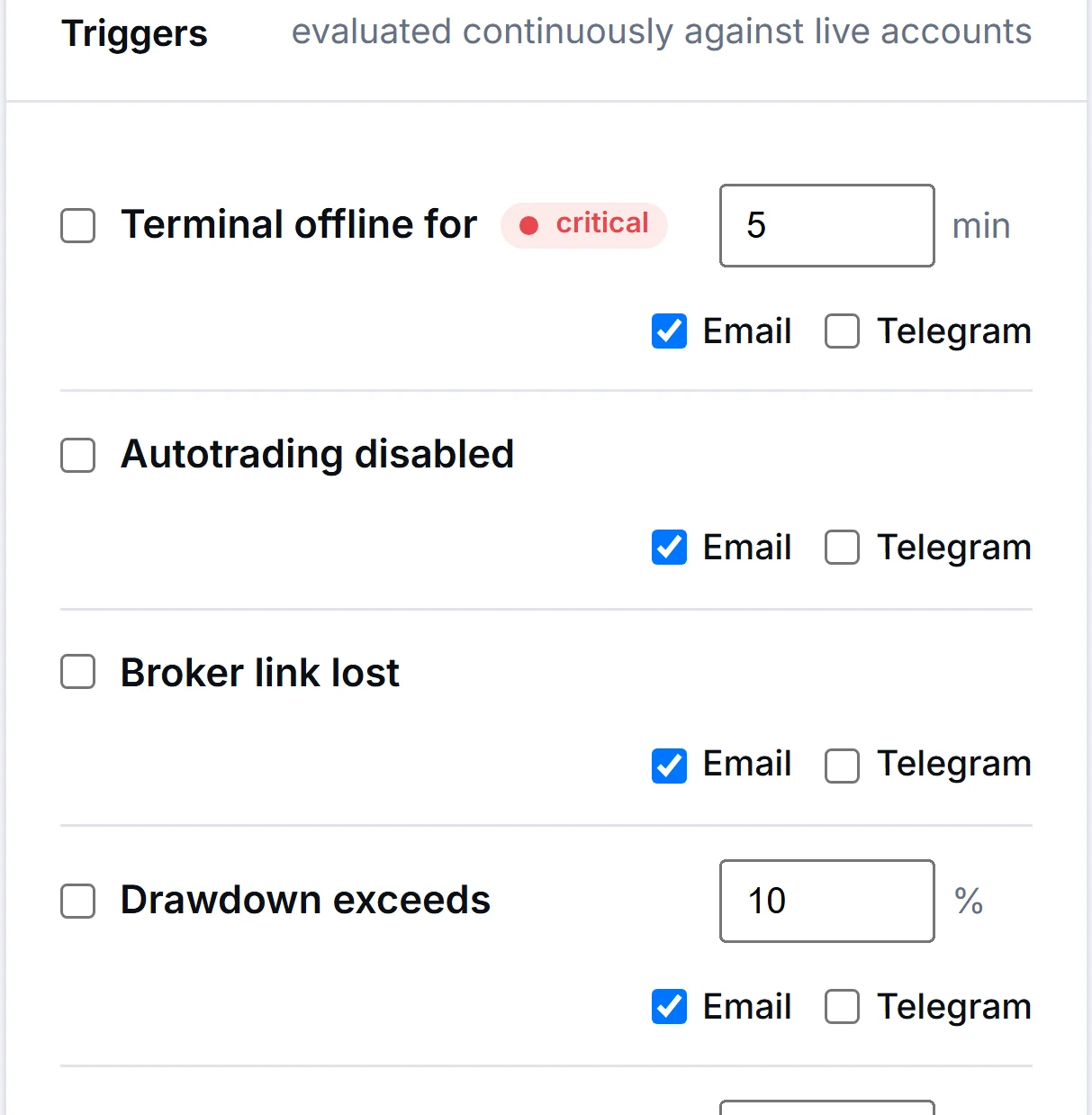
The alert is only as good as the number behind it. Karnek reads live equity straight from the terminal through its heartbeat — not an end-of-day figure, not a delayed feed. That means it counts the floating loss on positions that are still open: the drawdown that hasn't closed yet but is every bit as real. When you cross 80%, the message reaches you by email or Telegram within moments, on whichever you've set up.
The Karnek note
Karnek can warn you that you're close to your limit — it can't stop the trade that takes you over it. It reads live equity read-only and sends the alert; closing positions or cutting size stays with you, or your EA. Think of it as a smoke alarm, not a sprinkler.
Written and reviewed by the Karnek Research team. Last updated August 2026.
Educational content only - not financial advice. Past performance does not predict future results. Trading carries significant risk.